
iTRACK-PN
A Digital Innovation for Index Testing Services
During FY 2025, the LAKAN network recorded 216 index testing cases with a high reactivity rate of 13%. In contrast, the CBS modality recorded 11,938 tests but yielded only a 1% reactivity rate. This shows highly opposing trends—index testing has low testing volume but high reactive yield, whereas CBS shows high volume but low yield.
Despite its high efficiency, there is currently no dedicated strategy implemented to strengthen index testing across the network, unlike the BESHTEST and ALTER strategies utilized under the SSNT modality. To address this gap, the iTRACK-PN Tool was developed in the middle of FY 2026 as part of the project's implementation.
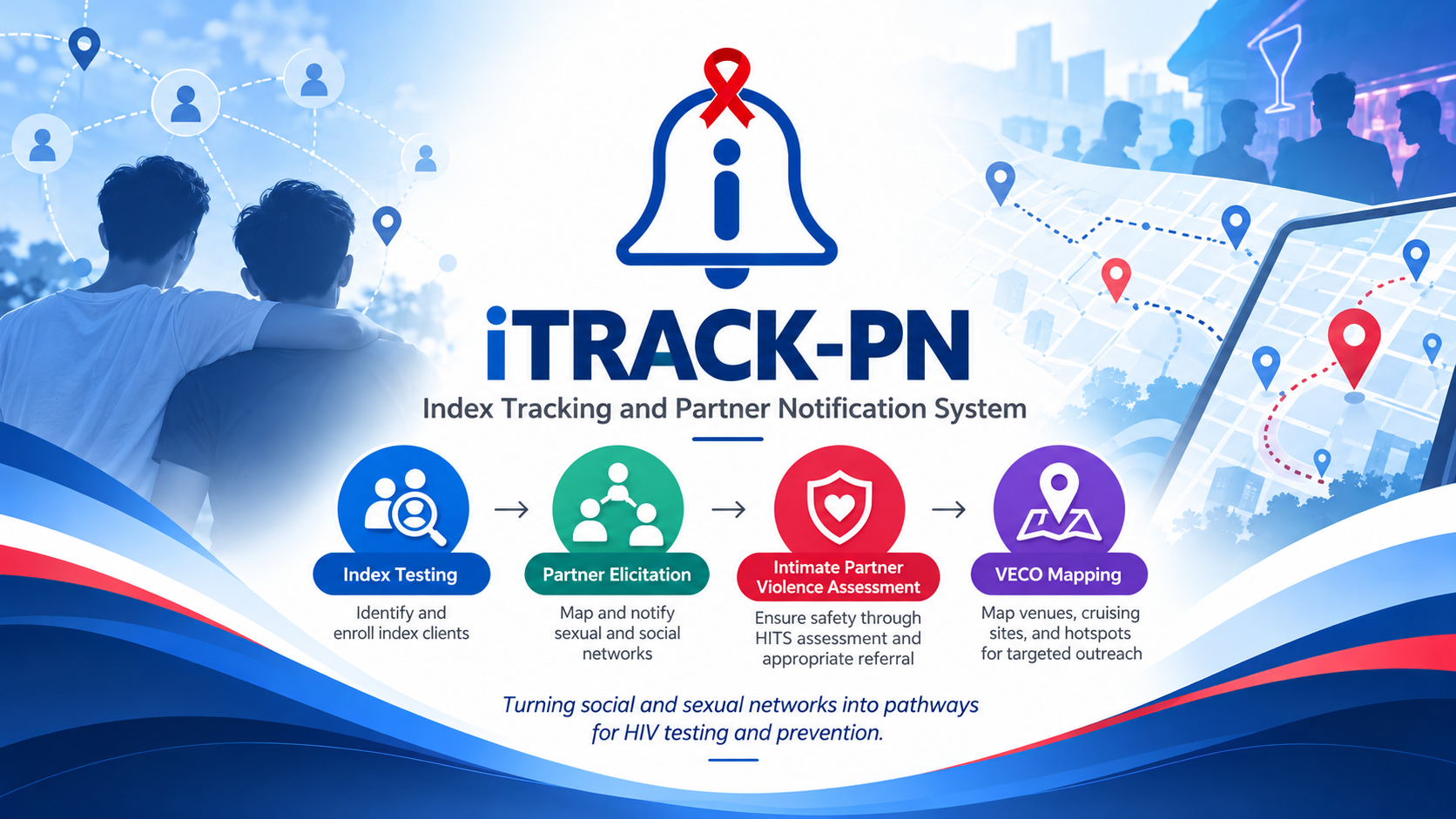
Developed by the Junior MNE under the supervision of the Senior MNE and Program Manager, the iTRACK-PN was created. iTRACK-PN is a digital tool designed to support field staff and case managers in conducting partner elicitation and intimate partner violence (IPV) assessment. It also enables case managers to monitor and track progress throughout the partner notification and index testing processes, as well as clients and indices linkage to HIV treatment and prevention services.
The workflow of the tool can begin either in the community-based setting (CBS) or within the facility-based testing (FBT) setting. Both modalities begin by obtaining the client's consent (see Figure A1 in Appendix) to complete the iTRACK-PN intake form, which includes the IPV assessment and partner elicitation.
In the IPV module, the iTRACK-PN tool uses the HITS (Hurt, Insult, Threaten, Scream) assessment to identify and assess the presence and history of IPV. It evaluates and assesses experiences of physical and verbal abuse, insults, threats, and other forms of abusive behavior. If IPV is identified in the integrated HITS form, a prompt with national helpline numbers (for women and child abuse) will appear (see Figure A2 in the Appendix). The client will then be referred to the case manager for further assessment and assistance based on the client's needs. Such services may include, but are not limited to, linkage to appropriate legal services, psychological support, and other relevant interventions.
As an integration of the CBS to index testing services, the tool features a digital partner elicitation form through which clients with reactive HIV screening results are asked to provide informed consent before sharing information about their potential index partners, including biological children and/or sexual partners. The form also incorporates a geomapping feature that allows clients to identify the locations of their cruising sites by dropping pins on a map. This feature supports the mapping of potential hotspots to inform targeted community outreach and HIV testing activities (see Figure A8 in the Appendix)..
This innovation may help in the case management of index cases graphically by using an index network map to easily see the network connections among clients and indices. It is also equipped with badges to easily determine the IPV status, partner notification, HIV testing, and linkage status (see Figure A5 in the Appendix).
Aside from the local network map of a particular index case, a global view of the network map allows case managers and field staff to see the interconnections between multiple index cases (see Figure A3 and Figure A4 in the Appendix).
As a supplement to case managers and field staff in providing better index testing services to clients, a “Resources” section is added to the system (see Figure A7 in the Appendix). The Resources section contains index testing guidelines in accordance with DOH Administrative Order No. 2022-0035, consent and confidentiality FAQs, index testing and counselling, partner elicitation spiels and guides, and an interactive simulation of the HITS assessment tool.
The data monitoring and evaluation section is located in the “Analytics” section. This section provides the data needed for reporting as stated in Annex G.1. Index Testing (IT) Specific Guidelines, along with additional KPIs that can be used to evaluate index testing data (see Figure A6 in the Appendix).
iTRACK-PN may transform index testing into a smarter, safer, and more data-driven HIV service by integrating partner elicitation, IPV assessment, network mapping, partner notification, and linkage monitoring into a unified digital platform. Developed for the LAKAN Network, this innovation has the potential to empower field staff and case managers to strengthen case finding, support targeted outreach, and improve linkage to HIV treatment and prevention services, with its effectiveness to be evaluated through ongoing pilot implementation and monitoring and evaluation.
“There’s a way to do it better. Find it.“
-Thomas Edison (1847-1931), Inventor
Notes:
Data for the M&E framework are not yet available because pilot implementation is currently ongoing.
For field staff and case manager workflows, see flowcharts 1 and 2 in the appendix.